
Why Thin-Gauge Sheet Metal Laser Cutting (0.5–3.0mm) Requires a Different Approach
Thin-gauge sheet metal laser cutting (0.5–3.0mm) demands tighter heat control, smarter nesting and careful handling to prevent distortion and surface marking. Most laser cutting firms focus on heavier plate.
While fibre lasers are capable across a wide thickness range, materials between 0.5 mm and 3.0 mm behave very differently from industrial plate.
At MS Laser Services, we specialise exclusively in thin-gauge sheet metal laser cutting — supporting signage companies, fabricators, architects and OEM clients across the UK with consistent, repeatable production. If you need parts cutting, see our dedicated thin-gauge laser cutting service page.
Thin Sheet vs Heavy Plate — What Actually Changes?
When cutting thin-gauge sheet metal, several technical factors become critical:
1️⃣ Heat Input Control
Thin material absorbs heat quickly. Excess energy can cause:
- Warping
- Edge discoloration
- Micro-movement during cutting
2️⃣ Material Stability
Unlike heavy plate, thin sheet can:
- Vibrate
- Lift slightly during cutting
- Shift if micro-tabs are poorly placed
3️⃣ Surface Protection
Brushed, mirror and anodised finishes require careful handling to avoid marking.
4️⃣ Nesting Density
Thin sheet allows high-density nesting — but improper layout can increase distortion risk.
This is why cutting 1 mm stainless is not simply “easier” than cutting 10 mm steel. It requires a different workflow.
Common Problems When Cutting 0.5–3.0mm Sheet
Trade clients often approach us after experiencing issues with general laser providers:
- Distorted parts from excessive heat
- Burr formation on light gauge steel
- Micro-tabs snapping too early
- Surface scratches on decorative finishes
- Poor repeatability on small batch runs
These problems usually stem from parameters optimised for thicker material rather than thin sheet.
How We Optimise Fibre Laser Cutting for Thin Gauge
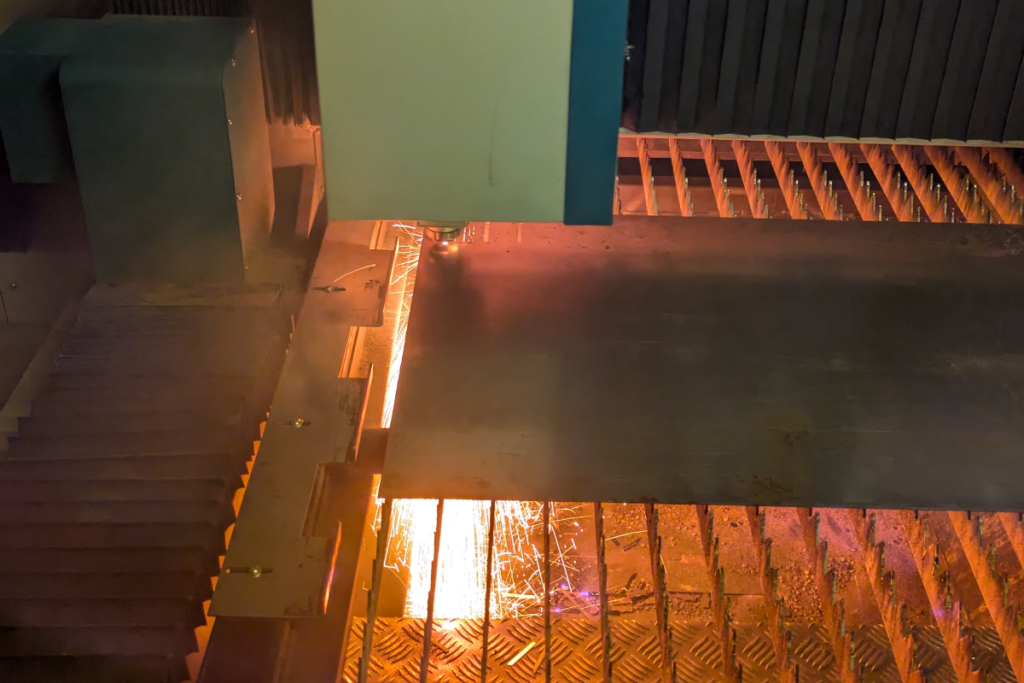
Our 3 m × 1.5 m fibre laser setup is calibrated specifically for thin-gauge sheet metal.
Key areas we control:
✔ Controlled Cutting Parameters
Optimised speed, power and gas flow for minimal thermal impact.
✔ Precision Nesting Strategy
We balance sheet utilisation with distortion control.
✔ Micro-Tab Placement
Tabs are positioned to retain geometry without damaging edges.
✔ Careful Material Handling
Particularly important for brushed, mirror and patinated finishes.
✔ Consistent Edge Quality
Clean, crisp laser-cut edges that require minimal post-processing.
All remnant jobs and production runs are processed through the same thin-gauge workflow, whether cutting stainless steel, aluminium, brass, copper or zinc.
When Thin-Gauge Laser Cutting Is the Right Choice
Thin-gauge fibre laser cutting is ideal for:
- Laser cut signage and lettering
- Decorative panels and feature screens
- Faceplates and control panels
- Bracketry and light enclosures
- Prototype components
- Architectural inlays
For lightweight work such as plates and tags, we also offer dedicated 1 mm aluminium laser cutting, optimised for minimal distortion.
If you’re working on a small batch or test run, our laser cutting with remnants option can significantly reduce material cost.
Why Subcontract Thin-Gauge Laser Cutting Makes Commercial Sense
For many sign makers, fabricators and OEMs, subcontracting thin-gauge cutting provides:
- No capital investment in machinery
- No maintenance overhead
- Scalable production capacity
- Access to in-stock sheet metal
- Fast turnaround on urgent jobs
- White label supply where required
By specialising in 0.5–3.0 mm material, we act as a dedicated thin-sheet partner rather than a general plate cutting shop.
Materials We Commonly Cut in Thin Gauge
- Aluminium (0.5–3.0 mm)
- Stainless Steel 304 & 316 (0.5–3.0 mm)
- Brass CZ108 & CZ120
- Copper (mill, brushed, mirror)
- Zinc (0.8–1.5 mm)
- Mild Steel & Corten (up to 3.0 mm)
You can view the full list on our sheet metal materials page.
Choosing the Right Specialist Matters
If you’re specifying thin-gauge sheet metal laser cutting (0.5–3.0mm), working with a specialist reduces the risk of distortion, rework and delays.
At MS Laser Services, thin sheet is not a side capability — it is our core focus.
Our workflow, nesting strategy and machine calibration are designed specifically for materials between 0.5 mm and 3.0 mm.
📩 Send your DXF file for a fast quotation
📞 Or call us on 0151 458 9039